
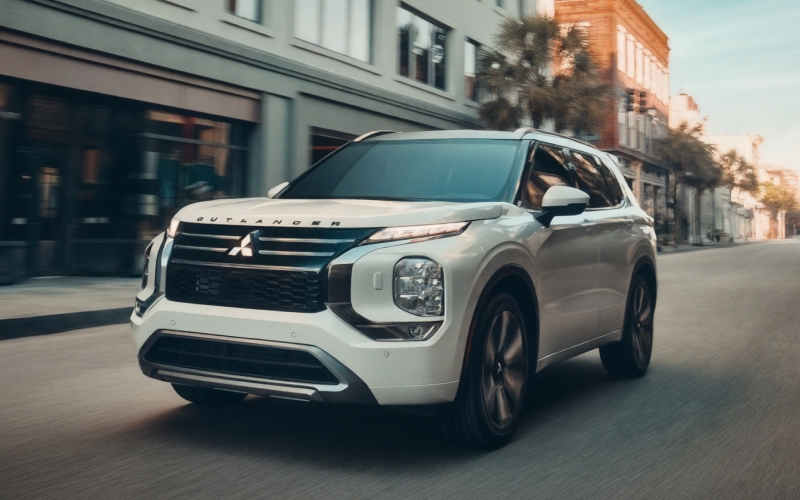
Prestige Mitsubishi - Which AWD system is better for winter roads around Chippewa Falls, WI — S-AWC on the 2026 Outlander or Real Time AWD on the 2026 CR-V?
When drivers ask which system inspires more confidence on snow, ice, and slush, the conversation often comes down to control sophistication and the breadth of available drive modes. Mitsubishi’s Super All-Wheel Control (S-AWC), available on the 2026 Mitsubishi Outlander, integrates front-rear torque distribution with selective wheel braking and power delivery to help the SUV track cleanly through changing traction. The mode selector adds Tarmac, Gravel, Snow, Mud, Normal, and Eco, enabling drivers to tailor the vehicle’s behavior to evolving conditions. Honda’s Real Time AWD™ on the 2026 Honda CR-V improves traction by routing power rearward when slip occurs, which is a beneficial baseline. However, Real Time AWD™ lacks the multi-mode tuning and the brake-and-torque coordination that define S-AWC, especially useful on crowned rural lanes, polished intersections, and rutted, refrozen surfaces common after Wisconsin plows pass.
Beyond traction theory, the Outlander’s practical touches strengthen winter confidence. Up to 8.3 inches of ground clearance helps manage berms and plow ridges. The available 360° Multi-View Camera System assists with snowbank-limited sightlines in parking lots and driveways. Rear Automatic Emergency Braking and Trailer Stability Assist add a layer of protection for backup situations and winter gear-hauling. And on the longer stretches that define regional commutes, available MI-PILOT Assist™ with Navi-link supports consistent lane centering and smooth Adaptive Cruise Control with Stop & Go. The CR-V’s Honda Sensing® suite is a proven asset for lane and distance support, and hybrid trims provide responsive low-speed power delivery, yet the Outlander’s S-AWC and winter-centric drive modes deliver more driver-selectable control for Wisconsin’s mix of snow types, thaw-refreeze cycles, and unplowed side streets.
- Traction strategy: S-AWC coordinates torque split and selective braking to help the vehicle rotate and track; Real Time AWD™ primarily engages the rear axle when slip is detected.
- Drive-mode depth: Outlander offers Tarmac, Gravel, Snow, Mud, Normal, and Eco; CR-V lacks dedicated off-pavement and deep-snow modes.
- Low-visibility backup support: Outlander’s available 360° Multi-View Camera and standard Rear Automatic Emergency Braking aid in tight, snowbanked spaces.
- Winter-ready hardware: Outlander brings up to 8.3 inches of ground clearance and available heated amenities across multiple trims.
For many households, a test drive on familiar roads says more than any spec sheet. Plan a route that includes a plowed boulevard, a side street with frozen ruts, and a parking maneuver framed by snowbanks. Engage Snow mode in the Outlander and note steering correction and throttle smoothness. Then compare how the CR-V settles and recovers when surfaces switch mid-corner. The distinction is often clearest in that transition moment—S-AWC’s coordination can feel more natural and less reactive, which reduces fatigue on long winter days.
Prestige Mitsubishi offers guidance on how to choose between driveline technologies based on commute type, driveway grade, and the winter travel mix between city streets and unpaved cut-throughs. Our team is committed to clear answers and practical demonstrations, serving Chippewa Falls, Menomonie, and La Crosse with routes and scenarios that reflect real local conditions.
Frequently Asked Questions:
Does S-AWC help on dry pavement or only in snow?
S-AWC benefits extend beyond snow by coordinating cornering forces and traction when surfaces change—think rain-slick patches, gravel-strewn shoulders, or a dusty construction zone—then it adds Snow and Mud modes when winter or trail conditions call for extra help.
Will S-AWC reduce driver involvement or make the SUV feel artificial?
The system is calibrated to enhance stability while preserving a natural steering feel. In Normal mode, inputs are subtle; in Snow or Mud, assistance becomes more noticeable as the system works to maintain momentum and stability without abrupt intervention.
Is a 360° camera really useful in winter?
Yes. With snowbanks narrowing sightlines and pedestrians navigating plowed ridges, a 360° top-down view helps you confirm clearance, spot obstacles hidden in snow fog, and back confidently out of tight, iced-in spaces.
How does the Outlander’s mild-hybrid 48V system fit winter driving?
The 48V-BSG helps smooth restarts and bolster low-speed torque, which makes it easier to pull away cleanly on slick surfaces and maintain momentum in stop-and-go traffic without harsh engagement.